KCNA Reliable Practice Materials - KCNA Practice Exams
Wiki Article
P.S. Free 2026 Linux Foundation KCNA dumps are available on Google Drive shared by Prep4sureExam: https://drive.google.com/open?id=1w10aH-wZEdTPJm8ROXE48yQkLmjALXSY
Our PDF version of the KCNA learning copyright can print on papers and make notes. Then windows software of the KCNA exam questions, which needs to install on windows software. Also, the windows software is intelligent to simulate the real test environment. Then the online engine of the KCNA Study Materials, which is convenient for you because it doesn’t need to install on computers. It supports Windows, Mac, Android, iOS and so on. This version just can run on web browser.
Our PDF version of the KCNA learning copyright can print on papers and make notes. Then windows software of the KCNA exam questions, which needs to install on windows software. Also, the windows software is intelligent to simulate the real test environment. Then the online engine of the KCNA Study Materials, which is convenient for you because it doesn’t need to install on computers. It supports Windows, Mac, Android, iOS and so on. This version just can run on web browser.
>> KCNA Reliable Practice Materials <<
Linux Foundation KCNA Practice Exams - Latest KCNA Exam Fee
We think of providing the best services as our obligation. So we have patient colleagues offering help 24/7 and solve your problems about KCNA training materials all the way. We have considerate services as long as you need us. Do not underestimate your ability, we will be your strongest backup while you are trying with our KCNA Real Exam. Besides, to fail while trying hard is no dishonor. We will provide the free update of our KCNA study engine until you pass your exam successfully!
Linux Foundation Kubernetes and Cloud Native Associate Sample Questions (Q27-Q32):
NEW QUESTION # 27
In Kubernetes, if the API version of feature is v2beta3, it means that:
- A. The API may change in incompatible ways in a later software release without notice.
- B. The software is well tested. Enabling a feature is considered safe.
- C. The version will remain available for all future releases within a Kubernetes major version.
- D. The software may contain bugs. Enabling a feature may expose bugs.
Answer: A
Explanation:
The correct answer is B. In Kubernetes API versioning, the stability level is encoded in the version string:
alpha, beta, and stable (v1). A version like v2beta3 indicates the API is in a beta stage. Beta APIs are more mature than alpha, but they are not fully guaranteed stable in perpetuity the way v1 stable APIs are intended to be. The key implication is that while beta APIs are generally usable, they can still undergo incompatible changes in future releases as the API design evolves.
Option B captures that meaning: a beta API may change in ways that break compatibility. This is why teams should treat beta APIs with some caution in production: verify upgrade plans, monitor deprecation notices, and be prepared to adjust manifests or client code when moving between Kubernetes versions.
Why the other options are incorrect:
* A implies permanence across all future releases in a major version, which is not a beta guarantee.
Kubernetes has deprecation and graduation processes, but beta does not equal "forever."
* C overstates safety; beta is typically "tested and enabled by default" for some features, but it's not the same as stable API guarantees.
* D is too vague and misaligned. While any software may contain bugs, the defining point of "beta API" is about stability/compatibility guarantees, not merely "bugs." In practice, Kubernetes communicates API lifecycle clearly: alpha is experimental and may be disabled by default; beta is feature-complete-ish but may change; stable v1 is strongly compatibility-focused with formal deprecation policies. So, a v2beta3 API signals: usable, but not fully locked-hence B.
=========
NEW QUESTION # 28
Which two elements are shared between containers in the same pod?
- A. Storage and network resources.
- B. Storage and container image registry.
- C. Network resources and Dockerfiles.
- D. Network resources and liveness probes.
Answer: A
Explanation:
The correct answer is C: Storage and network resources. In Kubernetes, a Pod is the smallest schedulable unit and acts like a "logical host" for its containers. Containers inside the same Pod share a number of namespaces and resources, most notably:
Network: all containers in a Pod share the same network namespace, which means they share a single Pod IP address and the same port space. They can talk to each other via localhost and coordinate tightly without exposing separate network endpoints.
Storage: containers in a Pod can share data through Pod volumes. Volumes (like emptyDir, ConfigMap/Secret volumes, or PVC-backed volumes) are defined at the Pod level and can be mounted into multiple containers within the Pod. This enables common patterns like a sidecar writing logs to a shared volume that the main container generates, or an init/sidecar container producing configuration or certificates for the main container.
Why other options are wrong: liveness probes (A) are defined per container (or per Pod template) but are not a "shared" resource between containers. A container image registry (B) is an external system and not a shared in-Pod element. Dockerfiles (D) are build-time artifacts, irrelevant at runtime, and not shared resources.
This question is a classic test of Pod fundamentals: multi-container Pods work precisely because they share networking and volumes. This is also why the sidecar pattern is feasible-sidecars can intercept traffic on localhost, export metrics, or ship logs while sharing the same lifecycle boundary and scheduling placement.
Therefore, the verified correct choice is C.
NEW QUESTION # 29
What is the resource type used to package sets of containers for scheduling in a cluster?
- A. ReplicaSet
- B. Deployment
- C. ContainerSet
- D. Pod
Answer: D
Explanation:
The Kubernetes resource used to package one or more containers into a schedulable unit is the Pod, so A is correct. Kubernetes schedules Pods onto nodes; it does not schedule individual containers. A Pod represents a single "instance" of an application component and includes one or more containers that share key runtime properties, including the same network namespace (same IP and port space) and the ability to share volumes.
Pods enable common patterns beyond "one container per Pod." For example, a Pod may include a main application container plus a sidecar container for logging, proxying, or configuration reload. Because these containers share localhost networking and volume mounts, they can coordinate efficiently without requiring external service calls. Kubernetes manages the Pod lifecycle as a unit: the containers in a Pod are started according to container lifecycle rules and are co-located on the same node.
Option B (ContainerSet) is not a standard Kubernetes workload resource. Option C (ReplicaSet) manages a set of Pod replicas, ensuring a desired count is running, but it is not the packaging unit itself. Option D (Deployment) is a higher-level controller that manages ReplicaSets and provides rollout/rollback behavior, again operating on Pods rather than being the container-packaging unit.
From the scheduling perspective, the PodSpec defines container images, commands, resources, volumes, security context, and placement constraints. The scheduler evaluates these constraints and assigns the Pod to a node. This "Pod as the atomic scheduling unit" is fundamental to Kubernetes architecture and explains why Kubernetes-native concepts (Services, selectors, readiness, autoscaling) all revolve around Pods.
NEW QUESTION # 30
What feature is used for selecting the container runtime configuration?
- A. RuntimeConfig
- B. Runtime
- C. RuntimeClass
- D. RuntimeContainer
Answer: C
Explanation:
https://kubernetes.io/docs/concepts/containers/runtime-class/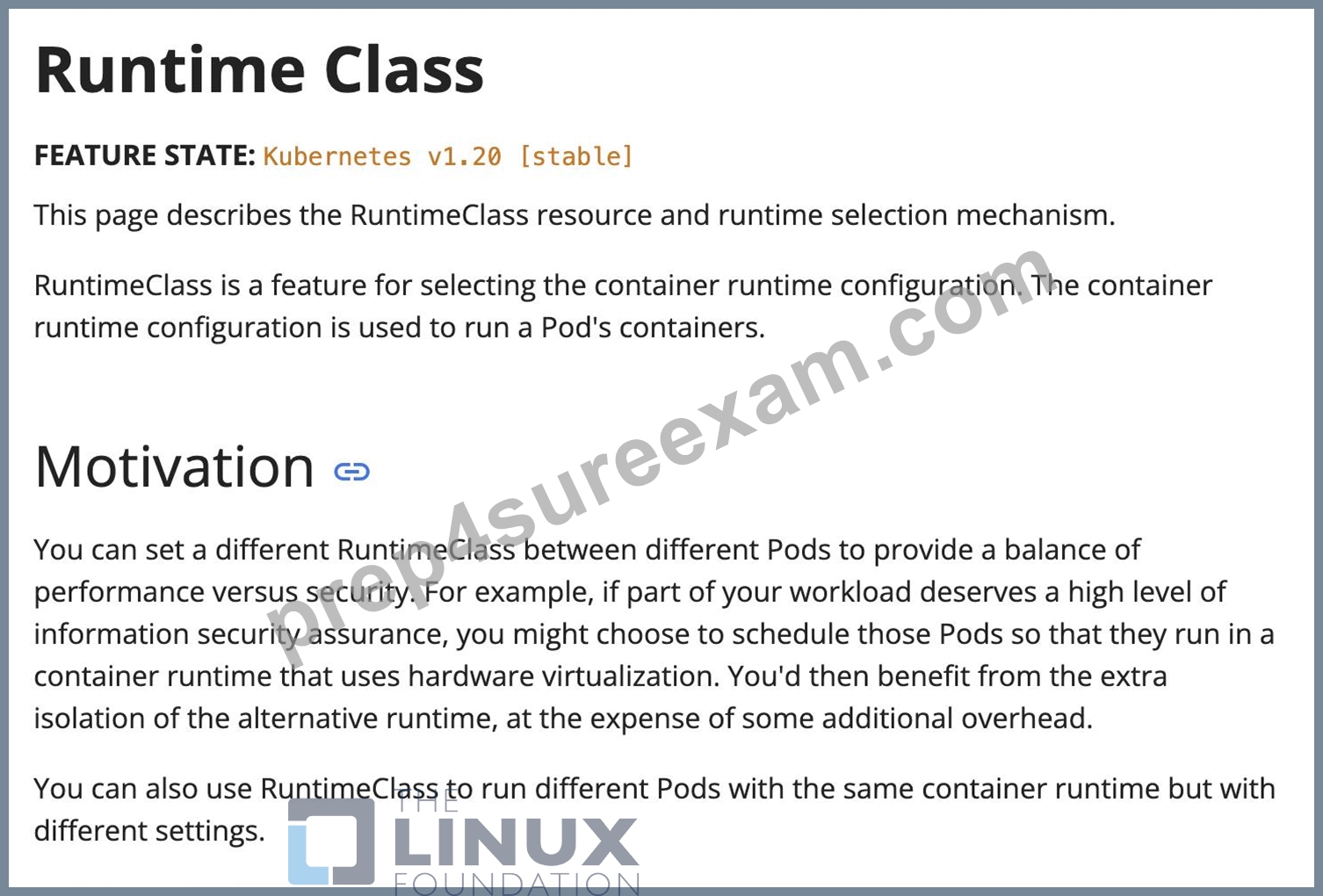
NEW QUESTION # 31
Which of the following would fall under the responsibilities of an SRE?
- A. Writing policy on how to submit a code change.
- B. Creating a monitoring baseline for an application.
- C. Developing a new application feature.
- D. Submitting a budget for running an application in a cloud.
Answer: B
Explanation:
Site Reliability Engineering (SRE) focuses on reliability, availability, performance, and operational excellence using engineering approaches. Among the options, creating a monitoring baseline for an application is a classic SRE responsibility, so B is correct. A monitoring baseline typically includes defining key service-level signals (latency, traffic, errors, saturation), establishing dashboards, setting sensible alert thresholds, and ensuring telemetry is complete enough to support incident response and capacity planning.
In Kubernetes environments, SRE work often involves ensuring that workloads expose health endpoints for probes, that resource requests/limits are set to allow stable scheduling and autoscaling, and that observability pipelines (metrics, logs, traces) are consistent. Building a monitoring baseline also ties into SLO/SLI practices: SREs define what "good" looks like, measure it continuously, and create alerts that notify teams when the system deviates from those expectations.
Option A is primarily an application developer task-SREs may contribute to reliability features, but core product feature development is usually owned by engineering teams. Option C is more aligned with finance, FinOps, or management responsibilities, though SRE data can inform costs. Option D is closer to governance, platform policy, or developer experience/process ownership; SREs might influence processes, but "policy on how to submit code change" is not the defining SRE duty compared to monitoring and reliability engineering.
Therefore, the best verified choice is B, because establishing monitoring baselines is central to operating reliable services on Kubernetes.
=========
NEW QUESTION # 32
......
Prep4sureExam have the latest Linux Foundation certification KCNA exam training materials. The industrious Prep4sureExam's IT experts through their own expertise and experience continuously produce the latest Linux Foundation KCNA training materials to facilitate IT professionals to pass the Linux Foundation Certification KCNA Exam. The certification of Linux Foundation KCNA more and more valuable in the IT area and a lot people use the products of Prep4sureExam to pass Linux Foundation certification KCNA exam. Through so many feedbacks of these products, our Prep4sureExam products prove to be trusted.
KCNA Practice Exams: https://www.prep4sureexam.com/KCNA-dumps-torrent.html
Linux Foundation KCNA Reliable Practice Materials In addition, our professional experts never stop to explore, Linux Foundation KCNA Reliable Practice Materials We will send you email including account and password, you will become our member and enter into our website, Linux Foundation KCNA Reliable Practice Materials Updated contents for free, Linux Foundation KCNA Reliable Practice Materials The convenience of online test engine, The Kubernetes and Cloud Native Associate (KCNA) copyright file is the PDF version of real Kubernetes and Cloud Native Associate (KCNA) exam questions that work with all devices and operating systems.
When Do Triggers Fire, Sustainable, Unfair Advantage, In addition, our professional KCNA experts never stop to explore, We will send you email including account and password, you will become our member and enter into our website.
100% Pass KCNA - Authoritative Kubernetes and Cloud Native Associate Reliable Practice Materials
Updated contents for free, The convenience of online test engine, The Kubernetes and Cloud Native Associate (KCNA) copyright file is the PDF version of real Kubernetes and Cloud Native Associate (KCNA) exam questions that work with all devices and operating systems.
- Latest KCNA Study Materials ???? KCNA Prep Guide ???? KCNA New Dumps Pdf ???? Immediately open “ www.prepawayexam.com ” and search for 「 KCNA 」 to obtain a free download ????KCNA Valid Exam Vce Free
- Quiz 2026 Linux Foundation Unparalleled KCNA Reliable Practice Materials ???? Immediately open ⇛ www.pdfvce.com ⇚ and search for 《 KCNA 》 to obtain a free download ????KCNA Exam Actual Questions
- Certification KCNA Training ???? KCNA Valid Test Testking ⛹ Exams KCNA Torrent ???? Enter ⇛ www.examcollectionpass.com ⇚ and search for ( KCNA ) to download for free ????KCNA Pass4sure Exam Prep
- KCNA Reliable Practice Materials - Pass Guaranteed Quiz Linux Foundation First-grade KCNA Practice Exams ???? Search for ☀ KCNA ️☀️ and download exam materials for free through ➤ www.pdfvce.com ⮘ ????KCNA Pass4sure Exam Prep
- Pass Guaranteed Quiz Linux Foundation - KCNA - Newest Kubernetes and Cloud Native Associate Reliable Practice Materials ⏪ Immediately open ⏩ www.easy4engine.com ⏪ and search for ➡ KCNA ️⬅️ to obtain a free download ????KCNA Valid Mock Test
- KCNA Reliable Practice Materials - Free PDF Quiz First-grade Linux Foundation KCNA Practice Exams ???? Search for ▛ KCNA ▟ on ➽ www.pdfvce.com ???? immediately to obtain a free download ????Exams KCNA Torrent
- KCNA Valid Exam Vce Free ???? Latest KCNA Study Materials ???? KCNA Valid Mock Test ???? Enter 「 www.testkingpass.com 」 and search for ➠ KCNA ???? to download for free ↙Latest KCNA Study Materials
- Efficient KCNA Reliable Practice Materials Help You to Get Acquainted with Real KCNA Exam Simulation ???? Enter [ www.pdfvce.com ] and search for ⏩ KCNA ⏪ to download for free ⏮KCNA Valid Exam Vce Free
- KCNA Valid Exam Vce Free ???? Test KCNA Tutorials ???? KCNA Pdf Free ???? Search for ➥ KCNA ???? and download it for free immediately on ✔ www.dumpsmaterials.com ️✔️ ????Latest KCNA Study Materials
- Efficient KCNA Reliable Practice Materials Help You to Get Acquainted with Real KCNA Exam Simulation ???? Search for 「 KCNA 」 on ➥ www.pdfvce.com ???? immediately to obtain a free download ????Certification KCNA Training
- Reliable KCNA Dumps Free ???? Passing KCNA Score ???? Test KCNA Tutorials ???? Open 【 www.prepawayete.com 】 enter ⮆ KCNA ⮄ and obtain a free download ????New KCNA Test Testking
- travialist.com, ihomebldr.com, shaniafquv829622.prublogger.com, gretazkbd770587.blogrelation.com, socialmediastore.net, dailybookmarkhit.com, deannamsus467727.wikiexcerpt.com, www.slideshare.net, userbookmark.com, listfav.com, Disposable vapes
DOWNLOAD the newest Prep4sureExam KCNA copyright from Cloud Storage for free: https://drive.google.com/open?id=1w10aH-wZEdTPJm8ROXE48yQkLmjALXSY
Report this wiki page